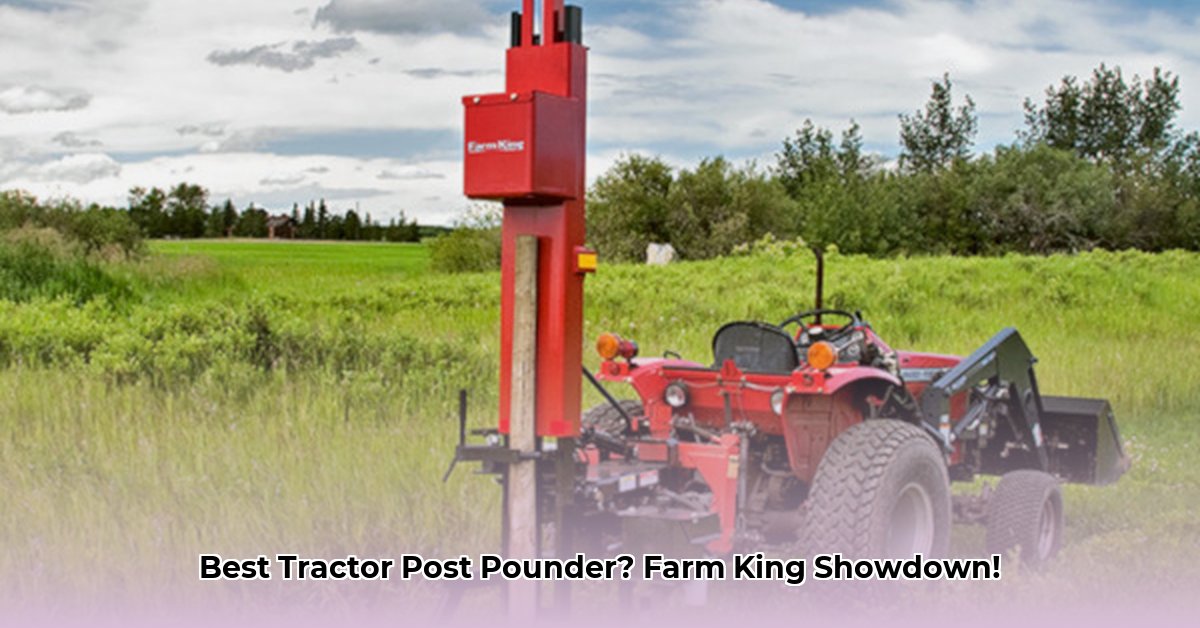
Choosing the right tractor post pounder is crucial for efficient and effective fence building and various construction projects. This article compares two popular Farm King models—the 1450 and the 2400—to help you make an informed decision. We'll analyze their specifications, capabilities, and suitability for different applications, offering a practical buying guide and addressing potential risks.
Farm King Post Pounder Models: 1450 vs. 2400
Farm King offers two primary tractor-mounted post pounders: the 1450 and the 2400. While both deliver significant impact force, their designs cater to different needs and scales of operation.
Farm King 1450: The Versatile Workhorse
The Farm King 1450 is a three-point hitch model, meaning it directly connects to your tractor's three-point hitch system. This offers ease of installation and operation, making it ideal for smaller projects and simpler applications. It's a cost-effective solution for farmers or contractors tackling smaller-scale fencing or construction projects. Think of it as the reliable workhorse for everyday tasks. Is this simplicity worth the trade-off in power for larger jobs? That depends on your needs.
Farm King 2400: Power and Adaptability
The Farm King 2400 is a more powerful and versatile option. It offers dual power sources: your tractor's PTO (Power Take-Off) or an independent engine. The PTO option offers seamless integration with your tractor, while the independent engine provides greater flexibility—ideal for situations requiring post-pounding away from your tractor or in cases where your tractor is unavailable. This is a true powerhouse, suitable for large-scale operations, challenging soil conditions, and projects demanding greater impact force.
Comparative Analysis: Farm King 1450 and 2400
The following table summarizes the key differences between the Farm King 1450 and 2400 models:
| Feature | Farm King 1450 | Farm King 2400 |
|---|---|---|
| Power Source | Tractor's 3-Point Hitch | PTO or Independent Engine |
| Impact Force | Approximately 100,000 lbs | Approximately 100,000 lbs |
| Hammer Weight | Variable, depends on added ballast | Variable, depends on added ballast |
| Mounting Options | 3-Point Hitch | PTO, Independent Engine |
| Ideal Use Case | Smaller projects, straightforward applications | Larger projects, greater versatility |
| Typical Cost | Lower | Higher |
Farm King 1450: Pros and Cons
Pros: Simple operation, ease of maintenance, lower cost.
Cons: Limited versatility, may struggle with extremely dense soil or larger posts.
Farm King 2400: Pros and Cons
Pros: Greater versatility, increased power, adaptability to various conditions.
Cons: Higher cost, potentially more complex maintenance.
Market Overview and Competitive Landscape
The market for tractor-mounted post pounders is diverse, with several manufacturers offering various models. Prices for new equipment vary significantly depending on features and power, ranging from several thousand dollars for entry-level models to considerably more for high-end units. The used equipment market offers a range of options at lower prices, but thorough inspection is crucial to assess condition and avoid costly repairs. Online marketplaces, such as TractorHouse, provide an excellent resource for exploring available options and comparing prices. Checking listings will reveal the wide price variance between new and used equipment.
Buying Guide: Choosing the Right Post Pounder
Selecting the right post pounder requires careful consideration:
- Assess your needs: Determine the scale of your projects and the typical soil conditions.
- Define your budget: Consider both initial cost and potential maintenance expenses.
- Research competitors: Explore models from other manufacturers to compare specifications and features.
- Evaluate long-term value: Calculate the return on investment considering the machine's lifespan and durability.
Risk Assessment and Mitigation
Purchasing a post pounder represents a significant investment. Here’s how to minimize risk:
- High Initial Cost: Explore financing options and compare prices from different suppliers.
- Maintenance: Implement a regular maintenance schedule according to the manufacturer's recommendations. This will help prevent more costly repairs down the line.
- Equipment Failure: Purchase from reputable dealers who offer warranties.
- Operator Safety: Ensure proper training and adherence to all safety guidelines for operators.
Conclusion
Choosing between the Farm King 1450 and 2400 depends on your specific needs and budget. The 1450 is a cost-effective and easy-to-use option for smaller projects, while the 2400 offers greater power and versatility for large-scale applications. Careful consideration of project scope, soil conditions, and long-term costs will ensure you select the best post pounder for your tractor and your operation.